Using AI: Packaging

This article originally appeared in our newsletter, which we publish 3–4 times a year. Sign up to receive future updates directly in your inbox!


When I tell people I’m a software developer working on Bible translation software, most people inevitably ask, “How is AI affecting what you do?”

I was a bit apprehensive about using AI at first, but I’ve come to see it as a valuable tool for saving time and reducing repetitive work. Throughout my career, I’ve seen tools evolve to take care of more of the tedious details of writing software, allowing developers to focus on solving problems.

When I started as a software developer, we used plain text editors. I had to be careful to get the code right, and I did much of the work myself. Over time, editors became more sophisticated. They learned to recognize the programming language I was using and could help me work with the functions and libraries available. I still had to research which libraries to use and figure out how to use them, but these tools made the job easier. The changes came gradually, each one helping me work a little more efficiently.

Each of these changes made me a little more productive, but AI feels different. Rather than simply helping me write code more efficiently, it allows me to hand off tasks that I would previously have had to figure out and do myself. It opens up new possibilities for how I approach my work.

My work involves much more than just writing code. Because we have a small team, I wear many hats—taking on tasks that might be handled by several different people on a larger team. AI gives me a way to delegate some of the more routine work so I can focus on solving the problems that matter most to our mission of making Scripture available to people in their own languages.

Here’s one example.

Whenever we release a new version of our software, we have a series of steps to complete for each platform we support: Windows, macOS, and Linux. Two summers ago, we had a student project to revamp how we package our Linux software for distribution through Flathub, making it possible to run on a wide range of Linux distributions. The new approach worked, but releasing updates still involved quite a few manual steps.

While preparing our 14.7 release this week, I decided to describe the existing process to Claude, an AI assistant, and asked how I could improve it. Within an hour, I had an automated workflow that detects changes to our source code and creates new Linux installers when a release is tagged.

That’s a big improvement! What had been a manual process is now automated, saving time with each release. Just as importantly, the process is no longer dependent on me being available. Other members of the team can handle releases without having to learn all the details of the packaging process.
This is just one example of how AI is becoming part of our day-to-day work. It helps us spend less time on repetitive tasks and more time building and improving the tools that support Bible translation.

In future articles, I’ll share more examples of how AI is helping us write software and how we are using it within the Scripture apps.
Scriptoria 2

This article originally appeared in our newsletter, which we publish 3–4 times a year. Sign up to receive future updates directly in your inbox!


Chris works on two products: Scripture App Builder (SAB) and Scriptoria. When we started developing SAB, we knew that helping organizations create contextualized Bible apps could eventually mean supporting thousands of apps. After all, there are more than 7,000 languages in the world! (Read more about apps in thousands of languages.)

Android is the primary smartphone platform for many of the communities we serve, but it changes every year. A Bible app created ten years ago still needs regular updates to keep working on the phones people use today. With thousands of apps in use, keeping them all up to date is a significant challenge.

Our first App Publishing Service focused on publishing apps through the Wycliffe USA Google Play Store. Later, we received funding to develop Scriptoria, which allows Bible translation organizations to keep their apps updated and available to their communities. This has become even more important as Google Play limits the availability of older apps on devices running newer versions of Android.

Each year, we release a new version of SAB that incorporates the latest Android libraries and other updates. All those apps need to be rebuilt and republished so that people can continue using them. Scriptoria makes that process much more manageable for the organizations responsible for these apps.

When we started Scriptoria, we didn’t have any web developers on our team, so we contracted outside developers to build it. Over time, improving Scriptoria became challenging. We needed to address some significant design flaws and performance problems, and we had learned a lot about web development while building our Scripture Progressive Web App (PWA). We decided it was time to modernize Scriptoria using the same technology stack—Svelte and DaisyUI—that we use for the PWA.

We released Scriptoria 2 at the end of 2025 (read the announcement). The new technology stack has made it much easier for us to maintain and improve the application. Since Aidan Jones joined our team, we’ve made many improvements. We also feel much more comfortable having students contribute to the project.

During the 2025–2026 school year, we worked with a Liberty University Capstone team to deliver two major improvements that we had wanted to make for years. It’s exciting to see how the new foundation is making it easier to tackle long-standing needs and continue improving Scriptoria.

Most importantly, Scriptoria is helping Bible translation organizations keep their apps up to date and available to the people who need them. Since 2019, it has been used to manage 3,255 projects, encompassing 5,999 products across 2,124 languages. During that time, those projects have resulted in 30,101 app publications.

Thank you for your support in making this work possible! Your support helps us maintain the tools that Bible translation organizations need to share God’s Word through technology.

Audio Download Manager Is Here

This article originally appeared in our newsletter, which we publish 3–4 times a year. Sign up to receive future updates directly in your inbox!


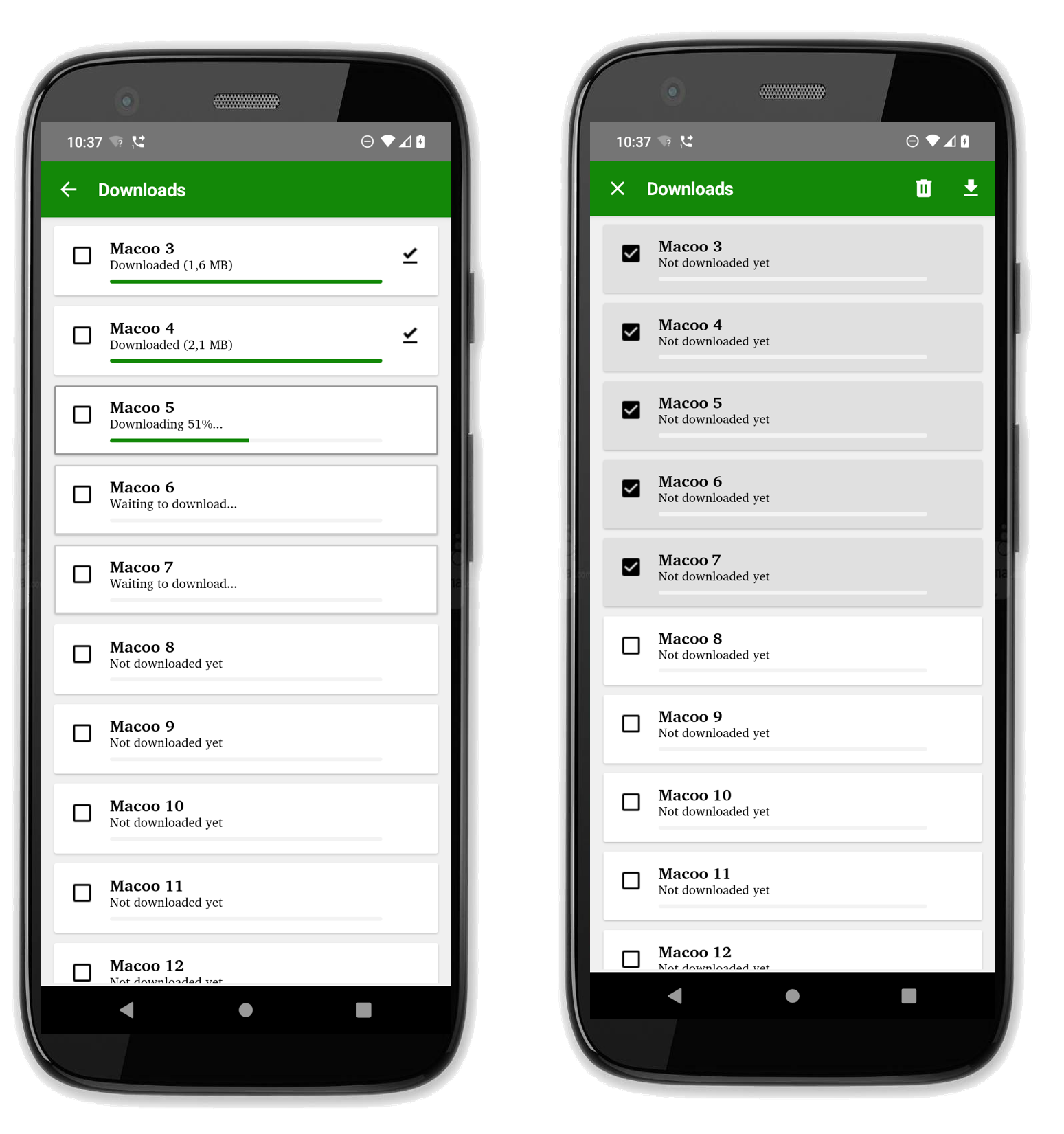
    One feature I’ve been waiting for is finally here: an Audio Download Manager for our Scripture apps. This means people can now download entire books or groups of chapters at once and listen even when they don’t have internet access. For many communities where connectivity is unreliable, this is a game-changer — giving them consistent access to God’s Word wherever they are. I’m excited to see how this will make Scripture more usable in daily life, and I’m grateful for your partnership that makes developments like this possible.

Apps in 2,000 languages!

This article originally appeared in our newsletter, which we publish 3–4 times a year. Sign up to receive future updates directly in your inbox!


Apps in 2000 languages

   We are really encouraged to see that Scripture App Builder has been used to make over 2,600 apps, now representing more than 2,000 of the world’s languages.

Progressive Web App … Ready!

    This has been an extremely busy year working on Scripture App Builder. Chris and his team have been working on the new Progressive Web App (PWA) template for two years. They released the new PWA in SAB 11.2 in March of 2024! However, there were still many missing features. This past summer, they had hoped for 1 or 2 interns to help them with the work. God blessed them with 6 interns to work on implementing these features. One of the interns was Mikayla, our daughter, who is studying Coding: App Development. It was such a joy for Chris to work with her this summer. Thank you for your continuing prayers for our team.

AI Assistant for Scripture Engagement?

   It’s not enough to translate the Bible; it’s not enough to distribute the Bible. Our desire is to see real Scripture Engagement: people encountering God’s Word in life-changing ways. 
    Scripture App Builder (SAB) is a tool for Bible translators and language workers to provide Scripture in a format that best meets the needs of the community and helps them engage with the Scripture. One of the challenges for new believers is how can they study the Bible and do that in community?
    We have introduced an EXPERIMENTAL feature in SAB 12.0 which allows the person building the app to enable an AI Assistant by providing some predefined tasks that the end user can perform on a whole chapter or selected verses. Here are some example tasks:

  • “Give me some Bible study questions”
  • “Share some devotional thoughts”
  • “Suggest ways to apply this to my life”
  • “Explain some key Greek or Hebrew words”
  • “Give me an outline of a talk”
  • “Write a poem”
  • “Show me the main points and structure of this passage”
  • “Tell me about the cultural, historical and geographical context”
  • “Show how this passage fits into the message of the book”

     When the user selects one of these tasks, the app will connect to a configured AI provider. It tells the AI the role it should play and the format of the responses it is looking for: “You are a helpful Christian assistant who believes in the reliability of the Bible, the importance of following Jesus as Saviour and Lord…” It then asks the AI service a question such as “Look at Mark chapter 8 in the Bible and write six discovery-style study questions which can be used in a participatory Bible study group.” The app writes the streamed response to the screen with a disclaimer at the end stating that the answer was generated by an AI assistant and to use its responses with discernment.
    What do you think? Would you like to try this out yourself? Contact Chris, and he will get you access to a beta of an app.

Progressive Web App … Almost Ready

    This year, Chris, his colleague David, and a team of students have been busy developing a new output format from Scripture App Builder which will expand the reach of Bible apps. This new format is a Progressive Web App (PWA) which is a website that can be used in a web browser or downloaded to a device and used when not connected to the Internet.
    We mentioned a few posts ago that we would have 3 new interns from Liberty University this summer. They were joined by one of the students from Gordon College who worked on it over the 2022-2023 school year. We made a tremendous amount of progress and it is almost ready to be released. We plan to release it early next year as a preview. We know that there will be features that we missed since every feature in SAB (so many!) had to be re-implemented for the web. We will work with end users to prioritize what is left to be done. Thank you for your prayers for our team this past year.

Language Technology Webinar

    Some of our staff members in the Language Technology department hosted a webinar recently to share some of the work we are involved with, showcasing some important developments in the Bible translation space. Please watch the recording to learn more about what Chris and his colleagues in Language Technology are doing.

New Scripture Engagement Features

   It’s not enough to translate the Bible; it’s not enough to distribute the Bible. Our desire is to see real Scripture Engagement: people encountering God’s Word in life-changing ways. 
    Scripture App Builder (SAB) is a tool for Bible translators and language workers to provide Scripture in a format that best meets the needs of the community and helps them engage with the Scripture. For many, literacy is challenging or non-existent, so listening to Scripture is very important. Some people in the community primarily watch videos, so the Jesus Film, Gospel Films, or their own films can be streamed from the app.
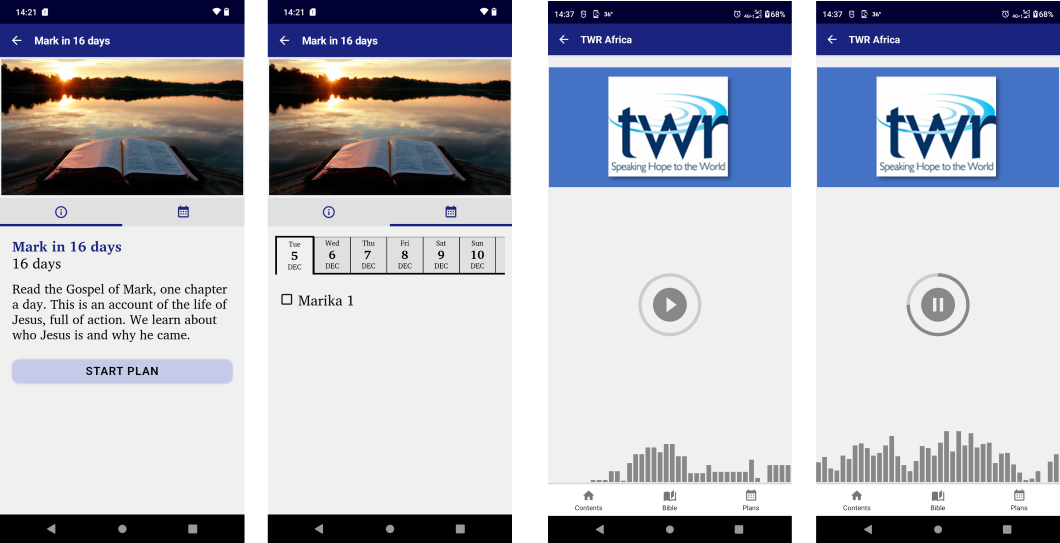
    For several years, reading plans have been a highly requested feature. SAB 11.1 was released last week and allows the person creating the app to add reading plans. They can select from pre-created plans included in SAB (like Proverbs in 31 days or Mark in 16 days), plans shared by the community (e.g. Biblica is sharing a 365-day plan of verses from Old Testament, New Testament, and Psalms/Proverbs every day), or create their own.
    Another new feature allows the person creating the app to include web radio (internet radio) stations in the app. Some of these stations can be found at https://streamurl.link including stations by long time ministry Trans World Radio.

Progressive Web App

    This year, Chris, his colleague David, and a team of students have been busy developing a new output format from Scripture App Builder which will expand the reach of Bible apps. This new format is a Progressive Web App (PWA) which is a website that can be used in a web browser or downloaded to a device and used when not connected to the Internet.
    Currently, users of SAB can create Android and iOS apps. We have been receiving feedback from users that they want to be able to just use the web browser on their phone or their desktop computer without having to install the app. One pastor in Thailand had an iPhone, but it was set up by a family member and they didn’t have the App Store password so they couldn’t install the app. One user didn’t have room on their phone for the app and just wanted to use the web browser to view a few chapters at a time. Other users in sensitive areas have their phones regularly scanned at checkpoints and it isn’t safe to install the app. Another user wanted to display the scripture on a projector using a desktop during a worship service and play the audio and have the text highlighted on the screen while listening.
    We have researched this in the past, but have not found the right set of software tools to make it possible. At the beginning of 2022, we found a library that would handle the Scripture processing. This past summer, we had an intern from Liberty University and Micah Henny, a friend from our sending church, work with us on developing a proof-of-concept to see if it was possible. We were able to create a viable PWA template that could be used with SAB to generate contextualized PWAs.
    In the fall, Chris and David worked with two separate senior capstone teams (from Gordon College and California Baptist University) to continue the work on the PWA template. The goal is to make a beta release available later this month at the EMDC conference.
    Last year’s student from Liberty University suggested that Chris work with Liberty on senior capstone projects as well. When Chris went to visit the school last month, we were able to talk to all the juniors studying Computer Science. From that presentation, three students have accepted unpaid internships for this summer and will be working with Chris and David on finishing the PWA template. Please pray for team to work well together, learn, and complete the work remaining.